
The Primary School Teacher Education Study Program (PGSD) successfully held the 2025 National Seminar on Primary School Teacher Education (SADE 2025) under the theme “Adaptive Schools through Digitalization and Local Wisdom Exploration.” The event took place at the Yusuf Abu Bakar Auditorium, University of Mataram, attended by around 600 participants consisting of students, lecturers, teachers, and education practitioners from various regions.
The seminar aimed to enhance teachers’ and PGSD students’ understanding and capability in addressing educational challenges in the digital era while upholding local wisdom as an integral part of Indonesia’s educational character. The theme of adaptive schools was chosen to emphasize the importance of adaptability among schools, teachers, and students in keeping pace with both technological and cultural developments.
The event began with a report from the organizing committee chair, Dr. Moh. Irawan Zain, M.Pd., who expressed gratitude to all participants and speakers. In his remarks, Dr. Irawan highlighted that SADE 2025 represents one of the concrete efforts of the University of Mataram to promote innovation in primary education through strengthening teacher competence and the effective use of technology—while preserving the local values inherent in the community’s culture.
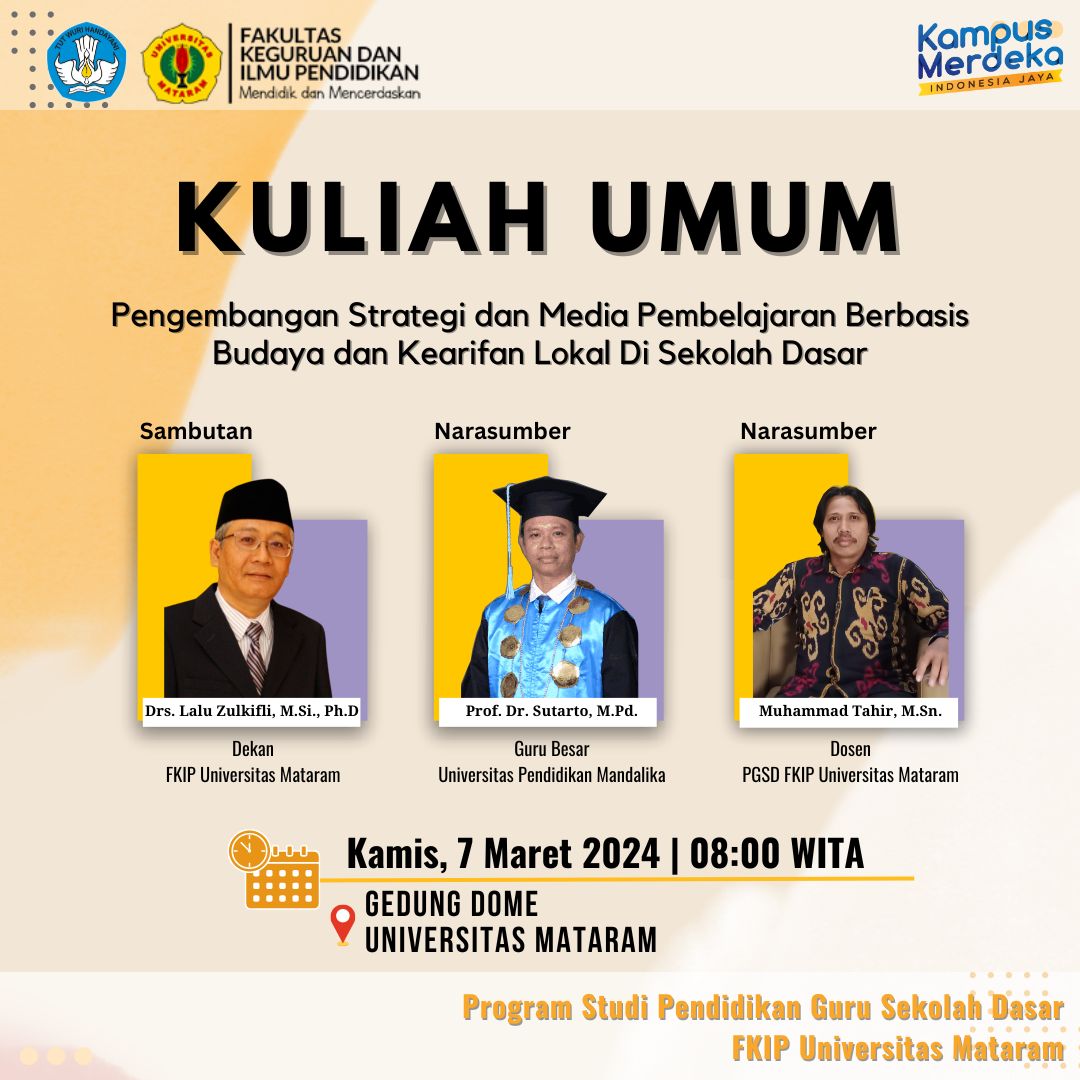
The seminar continued with an opening speech by the Dean of FKIP, Drs. Lalu Zulkifli, M.Si., Ph.D., who underscored the pivotal role of teachers in nurturing adaptive, creative, and character-driven young generations. The event was officially opened by the Director General of Teachers and Education Personnel, Prof. Dr. Nunuk Suryani, M.Pd., who commended the university’s initiative in organizing an academic forum that aligns with the contemporary needs of education. The opening ceremony concluded with a prayer led by Muhammad Sobri, M.Pd., followed by a group photo session involving speakers, participants, and committee members, both on-site and online.
The main session presented three featured topics delivered by distinguished education experts from various universities. The first topic, “Visualizing Mathematical Thinking Processes: Implementing Ethnomathematics Learning,” was presented by Prof. Dr. Supriadi, M.Pd. from the Indonesia University of Education, emphasizing how mathematics learning can be connected to local culture to enhance students’ conceptual understanding.
The second topic, “AI-Based Digital Learning Innovation in Primary Schools: Preparing Teachers and Students for the Technological Era,” was delivered by Dr. Dirgantara Wicaksono, M.Pd., MM. from Universitas Muhammadiyah Jakarta, exploring how digital and AI technologies can be integrated into the classroom and how teachers can prepare students for the digital age.
The third topic, “Adaptive Schools from the Perspective of Student Development: Challenges and Opportunities in the Era of Digitalization and Local Wisdom,” was presented by Prof. Dr. Darmiany, M.Pd. from the University of Mataram, who highlighted the need for a balanced approach between digitalization and the preservation of local values. This session was moderated by Dr. Ilham Handika, M.Pd. from the University of Mataram.
In his closing remarks, Dr. Moh. Irawan Zain, M.Pd., expressed his hope that the seminar would not only serve as a platform for academic exchange but also as an inspiration for teachers and PGSD students to apply innovative learning practices in their respective schools. He emphasized that educational digitalization should be viewed as an opportunity to improve learning quality, while local wisdom must remain the foundation for building students’ character.
Beyond being an academic forum, SADE 2025 also served as a platform to strengthen the network among educators from various regions. The active participation of both speakers and participants is expected to foster creative and innovative ideas for developing adaptive, high-quality, and culturally grounded primary education.
Through the successful organization of this seminar, the PGSD Study Program of the University of Mataram reaffirmed its commitment to advancing primary education that is adaptive, innovative, and rooted in Indonesia’s rich cultural heritage.